
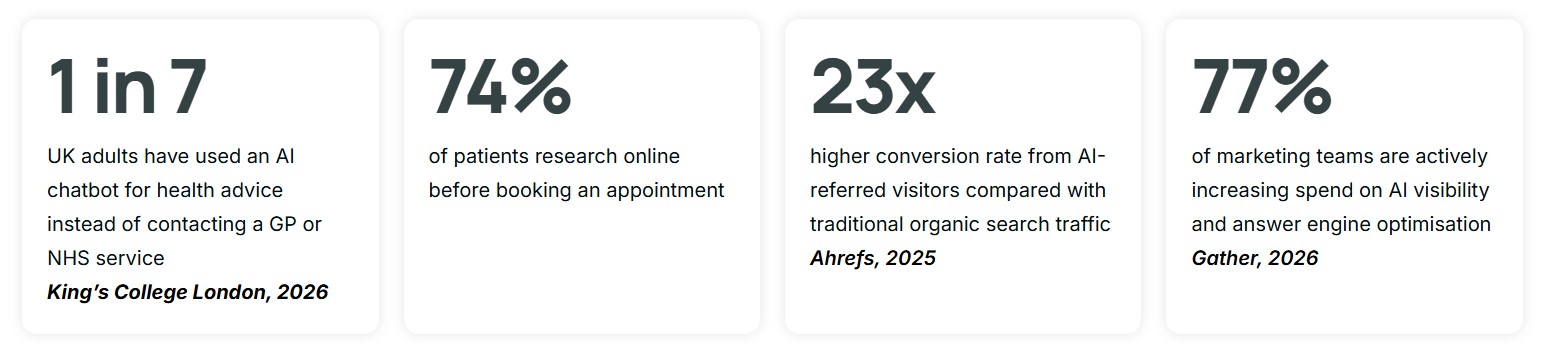
The way people search for their health and wellbeing has changed. Patients are increasingly turning to AI assistants and summaries that provide direct answers to their questions regarding health. Someone looking for support does not want to spend hours searching for answers. They ask a question, get an immediate response and decide what to do next.
For clinics, being that answer is not simply a marketing advantage. It is an opportunity to connect with potential patients and show them the services you provide and support them when they need it most.
Today, being discovered requires a combination of Search Engine Optimisation (SEO) and Generative Engine Optimisation (GEO). You have to ask yourself, “Can patients find my website?” and more importantly, “Will AI recommend my clinic when someone asks for help?”
How Searching for Support has Changed
The shift from typing a few keywords into Google and browsing through the results to asking an AI assistant a long-form question like “Where can I find support for my anxiety?” is quickly evolving as AI assistants become more mainstream.
This change is known as zero-click behaviour. Information on a broad spectrum of health topics is immediately available and recommended by LLMs and AI assistants without ever needing to go onto a company’s website.
For health and wellbeing clinics, this makes digital visibility more important than ever. Searches in this sector are often highly intent-driven. People looking for treatment are not searching casually; they actively need a service or support from someone they trust. So, clinics appearing in those moments have a greater opportunity to build trust and guide people towards the right care.
The Visibility Gap
Many health and wellbeing clinics have invested in a professional website and basic SEO. While these remain essential, they are no longer enough to compete in today’s search landscape.
AI search tools don’t simply rank websites in the way traditional search engines do. Instead, they build responses by analysing signals from across the wider digital ecosystem. Reviews, third-party mentions, professional directories, press coverage, structured content and consistent messaging all contribute to whether a clinic is recognised as a trustworthy source.
This creates a visibility gap. Clinics with experienced practitioners and excellent patient outcomes can still be overlooked if their digital presence doesn’t reflect their expertise. Meanwhile, competitors with stronger online authority may be recommended more often, even if they have less experience.
For health and wellbeing providers, the consequences of this are significant. Whether someone is searching for physiotherapy, counselling, dental care, nutrition support or a private health assessment, they are often looking for trusted care at an important moment. If they can’t quickly find a credible provider, they may delay booking an appointment or seek support elsewhere.
The search landscape is already changing rapidly. Research suggests that businesses adopting Generative Engine Optimisation (GEO) strategies have seen AI citations increase by as much as 218%, highlighting just how important visibility within AI-generated responses is becoming.
SEO & GEO: Clinics Need Both
SEO and GEO are often discussed separately, but they work best together.
Search Engine Optimisation (SEO) focuses on improving visibility in traditional search results. It includes technical website performance, local SEO, keyword research and creating content that helps your clinic rank for the services your patients are searching for.
Generative Engine Optimisation (GEO) focuses on how AI platforms interpret, understand and recommend your clinic. It requires content that is structured, authoritative and easy for AI to reference, supported by strong trust signals across the wider web.
For health and wellbeing clinics, this means creating informative service pages, answering common patient questions, maintaining accurate information across directories and building authority beyond your own website.
Together, these disciplines strengthen every stage of the patient journey. SEO helps people discover your clinic through search engines. GEO increases the likelihood that AI assistants recommend your clinic when people ask for advice or treatment recommendations directly.
How Serendipity Helps Clinics Get Found
Helping businesses become more discoverable online has been at the heart of Serendipity since 2010. By combining SEO, GEO, paid media, data science and creative strategy, the agency helps organisations build sustainable visibility across both traditional search engines and AI-powered platforms.
For health and wellbeing clinics, that means more than improving rankings. It means understanding where visibility is being lost, identifying opportunities for growth and creating a digital presence that reflects the quality of care you provide.
Serendipity’s free AI Growth Audit provides exactly that. Combining automated technical analysis with a review from an experienced strategist, the audit highlights where your clinic is performing well, where AI visibility can be improved and what practical actions will have the greatest impact.
Healthcare is built on trust, and your digital presence should reflect that. Every SEO and GEO strategy should help patients find the right information, build confidence in your expertise and make it easier to choose your clinic.
Looking Ahead
Whether someone is searching for treatment, rehabilitation, care or wellbeing support, they deserve to find the right clinic quickly and confidently. That only happens when providers are visible, credible and consistently represented across every platform and source that search engines and AI systems rely on.
Find Out Where Your Clinic Stands
Our free AI Growth Audit gives you a clear picture of your clinic’s visibility across search engines and AI platforms. Combining visibility analysis with a review from an experienced strategist, you’ll receive practical recommendations delivered to your inbox.